MARILYN MONROE
The Final Investigation Into a Suspicious Death
In the aftermath of Marilyn Monroe’s untimely and abrupt death, the Los Angeles Police Department (hereafter LAPD) conducted an investigation, even though the scene of her death indicated suicide as its cause. Sgt Robert Byron, an LAPD homicide detective, marshaled the investigation. As far as I have been able to determine, the Los Angeles County District Attorney’s Office (hereafter LACDA) was not involved in the original investigation; and the Chief Medical Examiner (hereafter CME), Dr. Theodore Curphey, did not convene a coroner’s inquest. Instead of an inquest, Dr. Curphey ordered the preparation of a psychological autopsy to examine Marilyn’s general mental health, specifically her mental health during the time immediately prior to her death. On Friday, August the 18th in 1962, a throng of television technicians and cameramen, and approximately fifty reporters, crowded themselves into the Coroner’s Inquest Room. Seated between psychologist Dr. Norman Farberow and psychiatrist Dr. Robert Litman, members of the team who performed Marilyn’s psychological autopsy, CME Curphey read the following statement:
Now that the final toxicological report and that of the psychiatric consultants have been received and considered, it is my conclusion that the death of Marilyn Monroe was caused by a self-administered overdose of sedative drugs and that the mode of death is probable suicide (Vitacco-Robles ICON: What Killed Marilyn Monroe [hereafter WKMM], v1:149).
With Dr. Curphey’s edict, the case of and the investigation into the untimely death of the beloved and inordinately famous actress reached its official termination. One of the reporters present asked Dr. Curphey: Does this report, today’s report, does this conclude the case? Accompanied by a smattering of subdued laughter and smiles, Dr. Curphey responded: I sincerely hope so (Vitacco-Robles ICON:WKMM, v1:149). Regrettably, as you must certainly know, such would not be the case.
Gary Vitacco-Robles reported, in the first volume of ICON: WKMM, that four official investigations into the circumstances revolving around Marilyn’s death have been conducted by various agencies of Los Angeles County (WKMM, v1:259). Subsequent to the initial investigation performed by the LAPD and the CME’s Office in 1962, thirteen years later in 1975, due to accusations of incompetence and malfeasance leveled by some journalists, but especially and particularly by Anthony Scaduto, the LAPD conducted a second investigation. By that time, the LAPD’s records pertaining to the original investigation had been purged, destroyed, standard operating procedure. Seven years later, in 1982, due to the provocative and sensationalized press conferences held by Robert Slatzer and Milo Speriglio, a private detective hired by Slatzer to investigate Marilyn’s death, the LACDA ordered a threshold re-investigation to determine if the original 1962 investigation contained misleading or false evidence or if new evidence uncovered during the two decades that had elapsed since Marilyn’s death indicated that she was a homicide victim. Such a monumental finding would have automatically triggered a new examination of her death.
As the Friday press conference neared its end, obviously seeking a clarification for the attachment of the word probable to Marilyn Monroe’s evident suicide, a reporter asked Dr. Curphey: Why wasn’t the verdict simply suicide? Dr. Curphey answered: Because she didn’t leave a note (WKMM, v1:148).1According to Robert Slatzer: Any detective will tell you that a person contemplating suicide invariably leaves a note of instruction, often stating the reasons for his suicide, even though such notes are not generally made public (Slatzer 328). Of course, and as usual, Slatzer was, and is, wrong: statistically, only thirty-five present of suicides leave notes.It must be noted here that not one of the official investigations resulted in a formal alteration of Dr. Curphey’s original 1962 edict or Marilyn’s official death certificate: the mode of Marilyn Monroe’s death has remained probable suicide.
How many independent, unofficial investigations into Marilyn’s death have been conducted during the past six decades plus four years? Establishing that quantity just might be an impossibility. Did each investigation result in a video documentary, a docudrama or a book promising the final word on the mystery of Marilyn’s death, promising finally, once and for all, to close her case? Quite possibly. Yes. Notably, during my many years researching Marilyn’s life and death, I have read one-hundred and twenty-seven books and watched, I conservatively speculate, at least one-hundred documentaries that claimed to be the result of a new examination of her death. Recently, over the course of a few hours, I searched Al Gore’s Amazing Internet for Marilyn Monroe documentary videos: I stopped searching after I had book marked one-hundred and two. Also, during that impromptu search, I encountered a video that I had never seen before, one video with three similar but different names: 1) Marilyn: A Counter Investigation Into a Suspicious Death; 2) Marilyn: The Ultimate Investigation Into a Suspicious Death; and 3) Marilyn: The Final Investigation Into a Suspicious Death. The producers of the video clearly chose title number three and the word final to induce the perception that their investigation, and the resultant documentary, was meant to be and would be the manifest final word regarding the circumstances and the facts related to the suspicious death of Marilyn Monroe.
A co-creation for television by two French film production companies, France 2 and Sunset Presse, with the participation of the Centre National de la Cinématographie, according to IMDb, the final investigation into Marilyn’s suspicious death aired on French TV sometime in 1999. Two years later, according to the Rotten Tomatoes website, the production sailed the Atlantic Ocean or crossed by rail the vast land mass to the east of Paris; and on August the 7th in 2001, thirty-nine years and three days following the date of Marilyn’s death, materialized on American TV. It is worth noting here, that Donald Spoto’s Marilyn biography had been in print for six years with the arrival of 1999 and eight years with the arrival of August 2001: Spoto’s biography was the first in Marilyn’s cañon to logically question, without sensationalism, her murder at the hands of the dastardly middle Kennedy brothers. Unfortunately, Sarah Churchwell’s perceptive excavation of Marilyn’s many biographical lives, and the many falsities contained therein, would not appear in print for three years.
A photographer and Marilyn’s friend, George Barris, was the French producer’s choice to be first in their line-up of on-camera testifiers. She was murdered, the photographer asserted three seconds into the video, and then he asked seriously, while staring into the camera lense: What else could it have been? The logical and scientifically correct answer to George’s query would have been: she committed suicide. But then George admitted: I don’t think she ever killed herself. He failed to admit that no amount of evidence proving suicide would change his opinion, a fine example of belief perseverance; and as Lee Ross and Craig Anderson have shown by experiments and research, deeply held beliefs or convictions, despite contraindicative evidence and testimony, can and often will remain entrenched and unshaken. According to the researchers, such beliefs can survive potent and logical or empirical challenges. Experiments and research also indicated that: 1) falsehoods are particularly difficult to discredit once implanted and a person or a group develops a rationale for accepting the falsehoods; and 2) beliefs can survive and even be bolstered by evidence that most uncommitted observers would agree logically demands some weakening of such beliefs. They can even survive the total destruction of their original evidential bases.2Ross, Lee and Craig Anderson. “Shortcomings in the attribution process: On the origins and maintenance of erroneous social assessments”, pp. 129-152. Judgement under Uncertainty: Heuristics and Biases. D. Kahneman, P. Slovic, and A. Tversky, Editors: Cambridge University Press, Cambridge. 1982.
Following the entrenched declarations by George Barris, Michael Rothmiller, a former undercover detective in the LAPD’s Organized Crime Intelligence Division (hereafter OCID),3The OCID was a division of the LAPD formed in 1946 by then Police Chief Clemence Horrall. The squad’s original purpose was to keep the East Coast Mafia and elements of organized crime from gaining a stronghold in LA. Locally, the intelligence unit became known by the name “Gangster Squad.” Evidently the squad morphed into an illegal aggregation of thugs that often broke more than a few laws “in the name of law and order.”reported this: It was a murder designed to look like a suicide; but despite that pronouncement, twenty-two years later, in 2021, Rothmiller would publish a book entitled Bombshell: The Night Bobby Kennedy Killed Marilyn Monroe. According to the author, he obtained the following confession from Peter Lawford in 1982: the British actor had watched as America’s attorney general heartlessly poisoned the world famous movie star on Saturday night, August the 4th in 1962. So, Rothmiller allegedly knew the ugly secrets in 1999; but he never said a word to anyone, not to anyone, for thirty-nine long years, essentially four decades, about what he purportedly had learned from Peter Lawford’s 1982 confession. Here’s the centrally important question. Why? Fear, of course, that he might be murdered by the criminal middle Kennedy brothers?
Like George Barris, Lawrence Schiller was a photographer. He snapped several nude shots of Marilyn as she filmed the swimming pool scene during her final but never completed film, Something’s Got to Give. Also known as Larry, he often spoke about Marilyn as if they were the best of friends; but such was not the case. In fact, the video’s narrator noted that Schiller considered Marilyn a partner—exactly what type of partner the narrator did not explain—but Schiller did not, however, consider Marilyn to be his friend. On camera, Schiller proffered the following opinion, the following hypothesis: I can see her getting more and more depressed, losing track of time—one pill, two pills, three pills. Thusly, Marilyn’s death was an accidental suicide according to Schiller’s belief; and yet, during the 1962 August 18th press conference with doctors Curphey, Farberow and Litman, a reporter asked a question directly related to Schiller’s hypothesis, that Marilyn’s suicide was an accident caused by drugged forgetfulness:
I want to know. Is there any shadow of possibility that she may have taken the drugs in a drugged state? Is there any history of this sort of thing?
Dr. Litman stated that he wanted to answer the reporter’s question.
There was not a case in the medical records where it could be authenticated that someone had died of barbiturate poisoning under the circumstances that you suggest—that is that they became so drugged that they didn’t know what they were doing and they took a lethal dose (Vitacco-Robles, WKMM, v1:146).
Jeanne Laverne Carmen, Marilyn’s purported best gal pal and one-time roommate, appeared on camera next. Marilyn was happier than she’s ever been, Jeanne announced, and then she qualified her announcement: outside those little things like Bobby, an insinuation that Marilyn’s little and niggling romantic affair with the Attorney General of the United States generated some unhappiness. Still and putatively, Marilyn’s deep, deep suicidal depression was allegedly the manifestation of Bobby’s heartless rejection; but despite what Jeanne announced, there is not any evidence whatsoever that Marilyn and Robert Kennedy were ever involved romantically or sexually. In fact, both had been apprised of the rumors regarding their nuclear love affair and each offered their firm denials. Marilyn told Susan Strasberg, Ralph Roberts and Norman Rosten, her poet friend, that she did not find Robert Kennedy physically appealing; and even though she liked the attorney general, liked his sense of humor and his civil rights agenda, Robert Kennedy was not her romantic type: Marilyn preferred tall, older and bespectacled men. Besides, there is not a shred of evidence which proves that Jeanne Carmen even knew Marilyn, that they were friends and that Jeanne was Marilyn’s confidant, not even one photograph, letter, birthday card or girlfriend note.
Regarding Robert Kennedy’s reaction to gossip, he was aware of other rumors about his personal life. Once, J. Edgar Hoover, director of the FBI, notified the attorney general of a recorded, eavesdropped conversation between the mobster Meyer Lansky and Lansky’s wife. During that recorded conversation, the mobster putatively stated that Robert Kennedy had once been involved sexually with a woman in El Paso, Texas. According to John Seigenthaler, Robert Kennedy’s administrative assistant, Hoover received a guardedly terse response from the attorney general, who noted that he had never visited El Paso and had never known a woman from that city; it follows, then, that the allegation was obviously baseless. He then stated a fact of which Hoover was most certainly aware, since the FBI director was one himself:4It is probably more accurate to call J. Edgar Hoover a quidnunc, a person who endeavors to learn and use all the latest gossip to achieve defamatory or negative ends.gossip-mongers just have to talk. Robert mentioned the rumor that he was currently or had once been involved with the actress Marilyn Monroe. At least I have met Marilyn Monroe, the attorney general informed Hoover, a good friend of my sister, Pat Lawford.“5“Fiction, Falsehood’ about the Kennedys.” John Seigenthaler. The Courier-Journal, Louisville, KY. Sunday. 8 Aug 1993
Yet another photographer, William Woodfield, appeared to testify next. Bobby Kennedy was supposedly in town, Woodfield proclaimed; and then, as if he was completing the sentence started by Woodfield, the attorney, John Miner, appeared and additionally proclaimed: and that would lead to the conclusion that Miss Monroe was murdered. With John Miner’s proclamation, what appeared to be the entire premise of the Final Investigation into the death of Marilyn Monroe had been established, a mere thirty-one seconds into the production. Marilyn did not commit suicide: ergo, the movie star was murdered due to her affair with the Attorney General of the United States, a myth as large as Turing’s Apple. Woodfield’s use of the word supposedly implied doubt and also that the photographer did not actually observe Robert Kennedy in Los Angeles. Woodfield merely repeated what he had been told. According to the Cambridge Dictionary, the word supposedly is normally used by a person to indicate that he or she does not actually accept as the truth something that they have been told.
But Wait! By the time we arrive at the end of this Final Investigation, the producers will do a vaguely ungraceful pirouette and tiptoe in another conspiratorial direction before deciding on a relatively prosaic reason, the actual reason, in their estimation, for Marilyn Monroe’s suspicious, untimely death.
Each time I have written a critique, or an analysis or an evaluation of a production by the media, whether literary or cinematic, appertaining to Marilyn Monroe’s life or her death, I have been confronted with the same fundamental dilemma: since I have written many thousands of words about the blonde actress, just how much repetition should I allow myself? Or more to the point, perhaps, since most of what has been written and filmed about Marilyn’s death is itself weedy repetition, and as evidence that she was murdered, as gossamer and as flimsy as cobwebs, just how far should I traipse into the repetitious and gossamer weeds? Well, as far as the French’s Final Investigation is concerned, I am going to denote a few falsehoods the producers advance as facts and then end this mild rant with a general summation of the video.
At 4 minutes and 12 seconds, the narrator asserted:
Marilyn’s death triggered a shockwave of emotion around the world but it was not an actress that was mourned but a myth. Her fans believed it was suicide. Nobody thought she had been murdered. The investigation was reopened in 1982 but not for long. 30 days later the judges closed the case without a word.
The preceding assertion contains both fact and fiction. Marilyn’s death did cause an eruption of emotion worldwide; however, not all of her fans readily accepted Dr. Curphey’s press conference edict that she probably committed suicide. In fact, a majority of her fans never believed, and still do not believe, that Marilyn committed suicide; she must have been murdered. Also, it is a fact that the LACDA’s office re-opened and re-investigated Marilyn’s case in 1982; however, the re-investigation spanned five months, not just thirty days; and the case was not closed without a word. The Assistant DA at the time, Ronald H. Carroll, and a lead investigator, Alan B. Tomich, along with several other investigators, reviewed the case files between the months of August and December, conducted additional interviews and addressed all the questions raised by various conspiracist writers. The LACDA’s office then published, in December of that year, a twenty-nine page summary report (hereafter SR), The Death of Marilyn Monroe: Report to the District Attorney, a copy of which I obtained in 2014 directly from the Los Angeles County District Attorney’s Office. And by the way. As far as I know, judges, meaning a governing judicial body, did not get involved in any way.
The producer’s reference to the re-investigation of 1982 led to a testimonial appearance by Anthony Summers, an Irish investigative journalist involved with the British Broadcasting Corporation. He wrote Goddess, a Marilyn pathography that Summers published in 1985. Regarding Marilyn’s death, Summers has been a proponent of the theory that Marilyn was murdered, that the middle Kennedy brothers were involved; and thereafter they orchestrated a massive cover-up. Only recently Summers altered his stance on Marilyn’s death, asserting that she died from an accidental overdose; however, the author has, as the years since Marilyn’s death accumulated, regularly vilified and ridiculed the SR, as have most, possibly even all, of the conspiracist writers. That group of journalists have cynically classified the re-investigation, and the resultant documentation thereof, as a self-serving deceitful miscellany, an orchestrated and a monumental hoax, just like her original autopsy.
In our French video, Summers is presented as an expert in American politics, an expert who possessed little or no interest in Hollywood or Marilyn Monroe for that matter; but he was, we are told, an experienced investigative journalist who sensed a massive scandal and an unsolved crime. Summers recalled:
Marilyn Monroe came into my life in the most curious way. I was in London and was talking to a colleague of mine who was the senior editor of a major London newspaper and we were discussing the fact that in Los Angeles the local authorities the district attorney’s office had reopened the probe into the death of Marilyn Monroe 20 years after the fact and this was a bizarre and one of the first things that I found to my astonishment was that nobody who knew what they were doing knew how to marshal facts and really delve into-into the matter had looked properly into her death. No wonder there was a mystery about her death. It had never been properly reported.
Anthony Summers rapidly realized that the heart of the mystery was the time of night at which [Marilyn] had been found apparently dead. While the official or accepted version was that she’d been found at 3:40 AM in the morning, Summers found himself talking to Natalie Trundy Jacobs, a very credible witness, according to Summers, who had been interrupted during a concert with her husband at the Hollywood Bowl on August the 4th in 1962. At that time, Natalie, an actress, was Arthur Jacobs6Arthur P. Jacobs, through his production company, APJAC, produced the five original Planet of the Apes movies. Natalie appeared as various characters in the final four movies produced by her husband.fiancé; and Jacobs owned the press agency that represented Marilyn. According to Natalie’s videotaped recollections:
This day I was at a concert at the Hollywood Bowl with Mr. and Mrs. Mervyn LeRoy and my husband Arthur Jacobs and in the middle of the concert they received through somehow situation that an emergency had arisen and he got up and left. It was not even half way through the concert so I would assume it was about 9 or half, half past, you know, half 9 in the evening.
The message had been received by the Hollywood Bowl and had been delivered due to some mysterious and unknown mechanism?—they received through somehow. Not exactly what I would call exacting or meticulous testimony; and according to Donald Spoto’s Marilyn biography, Natalie testified to him that an usher delivered the message to her then fiancé around 10 or 10:30 PM, just before the concert ended at 11:00 PM (Spoto 573). Marilyn biographer, Gary Vitacco-Robles, offered an astute appraisal of Natalie’s recollections and called into question the circumstances surrounding the delivery of the concussive message to Jacobs. Gary noted:
Unless Jacobs had regularly reserved a specific box, how would an usher locate him among the audience during a concert at the Hollywood Bowl to deliver the message? And who did the caller contact at the venue to relay the message?
Gary correctly noted, of course, that cell phones did not exist in 1962; and according to information published in the LA Times, the Hollywood Bowl’s box office would have closed at 9:00 PM. Gary then surmised, using the times Natalie attested to Donald Spoto, that the Hollywood Bowl’s box office would have been closed for ninety minutes when Trundy reported the message had been delivered7I have not been able to determine if the Hollywood Bowl had a published number that could be called in the case of an emergency.(Vitacco-Robles WKMM, v1:65).
Arthur left almost immediately, according to Natalie, and drove to Fifth Helena Drive, arriving there around 11:30 PM or 12:00 AM, where he conferred with some persons who were already at the hacienda. Arthur, she stated, left the hacienda only after a few minutes of conversation. A few days later, he told Natalie that the situation at Fifth Helena Drive was horrid. Natalie admitted to Spoto that Jacobs never provided any details: he commented only that the situation was too dreadful to discuss (Spoto 588). Since Natalie never asked Jacobs for any details, and he never volunteered any, then her knowledge of what transpired that tragic morning was, therefore, limited, certainly an inarguable fact. Additionally, Natalie Trundy’s testimony has never been corroborated. As far as I know, and have been able to determine, neither Mervyn LeRoy nor his wife, Kitty,8Mervyn LeRoy was born in 1900 in San Francisco, experienced the great Frisco earthquake and fire of 1906 and survived. He died on September the 13th in 1987. I have not been able to determine the fate of Kitty.ever commented regarding that Saturday evening. Also, I would be remiss if I failed to note that Natalie Trundy’s testimony regarding Arthur Jacobs’ movements that August night clearly qualified as hearsay that could not be corroborated by interviewing Arthur Jacobs: he had died from sudden heart failure in 1973.
Speaking only for me, of course, I am relieved that a London Newspaper dispatched Anthony Summers, political expert, consummate and crackerjack investigative journalist to Los Angeles in order to actually marshal facts and really delve into the matter and solve the mystery of Marilyn Monroe’s untimely death. The producers of the Final Investigation insinuated that Anthony Summers arrival in Los Angeles was somehow ceremonious, even heaven sent, somehow necessary for the resolution of the cause of Marilyn’s death; but was that actually the case? The summary report had already been released, absent any input from the consummate investigative expert; and the LACDA had concluded that, even though factual discrepancies exist and unanswered questions surfaced in our probe, the cumulative evidence available to us fails to support any theory of criminal conduct relating to her death (SR 2). The summary report ended with the following succinct statement: Based on the information available, no further criminal investigation appears required into Miss Monroe’s death (SR 29). The district attorney closed Marilyn’s case again. Still, accusations of misconduct and collusion by the LACDA, the LAPD, and all the other BIG letter acronyms that were allegedly involved in Marilyn’s death, persisted, even after the 1982 threshold re-investigation; and those accusations persist to this day.
Various biographers have asserted that Pat Newcomb discussed with Natalie Jacobs the events leading to Marilyn’s death: at the time, the two women were next door neighbors. However, Pat Newcomb has seldom discussed Marilyn Monroe, granted very few interviews or even mentioned Natalie Jacobs as far as I know or have been able to determine. Also, Natalie’s anecdote varied over the passing years, not only regarding the time the vital message was delivered to Arthur, but the person who actually placed the call to the Hollywood Bowl. She testified that Milton Rudin, Marilyn’s attorney, had placed the call from Peter Lawford’s beachside mansion; but she also testified: 1) that Milton Rudin had placed the call from Fifth Helena; 2) that Dr. Greenson, Marilyn’s psychiatrist, had placed the call, also from Fifth Helena; 3) that Patricia Newcomb had placed the call from an unknown location; and 4) Natalie even suggested, on one occasion, that the caller who reported Marilyn’s overdose could have been Peter Lawford, who called, yet again, from Fifth Helena Drive. Natalie also provided two accounts regarding how she returned home after Arthur received the message about Marilyn. In one account, the LeRoys drove her home, after the concert ended; in another account, she alleged that both she and Arthur left immediately after he received the message: Arthur drove her home on his way to Fifth Helena. At any rate, and more significantly perhaps, Natalie Jacobs is the only source for the Hollywood Bowl anecdote.
Twelve seconds past the two minute mark, the video’s narrator informs his listeners that Sgt Jack Clemmons, the first LAPD officer to arrive at Marilyn’s hacienda during the morning of August the 5th, did not agree with the official version of what happened to the movie star, meaning she did not commit suicide, meaning she was murdered. According to the narrator: Sgt Clemmons did not agree [with the suicide edict] and protested. Nobody listened and he was fired from the [police] force. The preceding declaration regarding the employment fate of Jack Clemmons was, and is, factually incorrect. Factually, the sergeant’s fourteen year career as a member of the LAPD came to an unethical and dishonorable end, his forced retirement his only punishment for participating in the Senator Thomas Kuchel defamation conspiracy that transpired in 1964.
According to the FBI’s files9Both the LAPD and the FBI investigated the defamation conspiracy at the request of Senator Kuchel.and memoranda on the conspiracy, Sgt Clemmons, along with anti-Robert-Kennedy crusader, Frank Capell, and two other men, former LAPD motorcycle COP, Norman Krause, and an industrialist, John Fergus, accused Senator Kuchel of driving under the influence, public drunkenness and publicly engaging in a homosexual act, all false and politically motivated, of course. Each of the four men filed false affidavits accusing Senator Kuchel, and Norman Krause swore that he had arrested the senator in 1959 for the said offenses. The conspiracy ended ignominiously. After three weeks of testimony from a host of credible witnesses, during February of 1965, a Grand Jury indicted the four men involved and charged each with conspiracy to commit criminal libel and wrongfully attempting to smear Senator Kuchel in order to affect his moral reputation. However, the four men agreed to plead either guilty or no contest to reduced misdemeanor charges; and they also agreed to publicly apologize to the senator. As part of the plea deal, the LACDA dropped the charges against Sgt Clemmons, who had been encouraged to resign from the LAPD prior to the issuance of the grand jury’s indictment. Sgt Jack Clemmons had axes to grind; and he did not appear as a testifier during the Final Investigation into Marilyn’s suspicious death: he had relocated his residence into eternity during early April of 1998.
Near the end of the video, John Miner appears on camera to assert: It is known and admitted that her housekeeper Eunice Murray was operating a washing machine at midnight after the death of her mistress. Why? To begin with, not one person, as far as I know, has ever admitted that Mrs. Murray was washing Marilyn’s bed clothes at midnight. Also, John Miner became the most vocal proponent of death by enema. Dr. Noguchi’s autopsy report noted that Marilyn’s colon was congested and discolored. This fact was a central gear in the machinery of Donald Spoto’s alternate theory regarding the movie star’s accidental death. According to Spoto, Dr. Greenson ordered Mrs. Murray to administer a sedative enema which irritated Marilyn’s sigmoid colon and ultimately caused her death. Well … it seems reasonable, Miner continued,
that some fluid and perhaps fecal matter had escaped during the administration of the barbiturate enema. And there is a reasonably good chance then that the discolored colon and the congestion were the product of the way in which the barbiturate came into Miss Monroe’s body.
Earlier in the video at the seven minute mark, John Miner testified: If by means of the barbiturate coming through the use of an enema the medical facts would be satisfied and that would lead to the conclusion that Miss Monroe was murdered. Therefore, whereas John Miner all but accused Dr. Greenson and Eunice Murray of murdering Marilyn Monroe, Donald Spoto relegated the star’s death to the status of accidental.
There are many problems with John Miner’s assessments and pronouncements—as many problems as Carter’s got little liver pills; and likewise, Donald Spoto’s alternate accidental death theory is afflicted with the same liver pill problems. That Eunice Murray happened to be operating an automatic washer and dryer did not appear in any of the three filed, official police reports; and not one person present that morning in August ever mentioned the discovery of Mrs. Murray doing the laundry after Marilyn Monroe had been pronounced dead.
In fact, the accusation and implication that Eunice got caught in the act of destroying evidence began in the 1980s with none other than Sgt Jack Clemmons: he never mentioned that detail contemporaneously. Twenty years after the fact, Mrs. Murray’s domestic activity was a creation provided by a man, a disgraced policeman who was not very trustworthy and who did not flinch at twisting the truth or creating false evidence that he presented as facts. Additionally, since Sgt Clemmons did not arrive at Marilyn’s hacienda until 4:25 AM, John Miner’s stipulated time of midnight, or 12:00 AM, certainly represents a chronological impossibility: would Eunice have needed nearly four and one-half hours to wash and dry a load of sheets?
Additionally, many of the conspiracists have asserted that the water supply to Marilyn’s hacienda had been disabled due to her on-going remodeling project. If we accept that dubious assertion to be fact, which I do not believe we should,10Disabling the water supply and leaving it disabled overnight would have created a very unsanitary situation.how could Eunice have been operating a washer? There are other indelicate issues pertaining to Marilyn’s colon and her autopsy that I will forego mentioning. Clearly, that Eunice Murray was doing the laundry during the early morning hours of August the 5th should be classified as fable. All that’s missing is the inclusion of dancing lambs and fairies!
Furthermore, it is clear from extant receipts, that Marilyn used “Cleaners A A Laundry,” a service located in Brentwood Heights; and as the receipts, pictured below, clearly indicate, Eunice Murray interceded with the laundry service for Marilyn. The movie star did not own a washer or a dryer, and her hacienda was not equipped with washer connections or a thru-wall dryer vent.
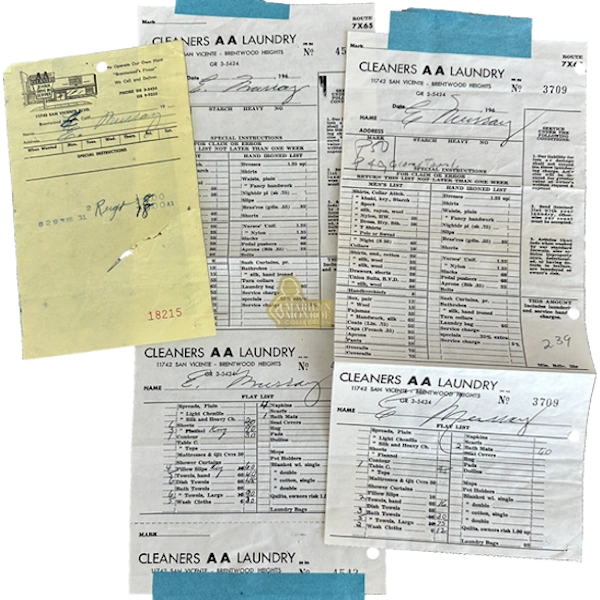
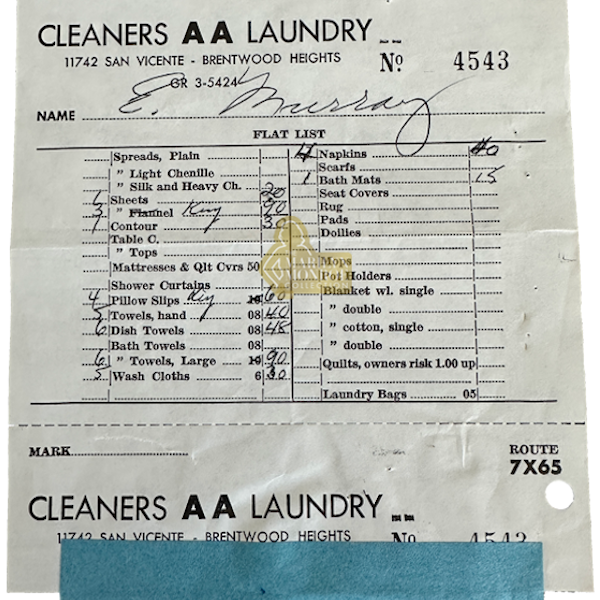
Receipts used with the permission of Scott Fortner and The Marilyn Monroe Collection, Scott’s fine MM website. Here’s a link to the site:
<https://themarilynmonroecollection.com/>
And here’s a link to Scott’s article about the Laundry Receipts: <https://themarilynmonroecollection.com/collection/marilyn-monroe-brentwood-laundry-receipts/>
At 11 minutes and 10 seconds, the producers asserted that the man of Marilyn’s dreams was John Kennedy. However, according to Susan Strasberg, Marilyn’s close friend and the daughter of Lee and Paula Strasberg, Marilyn admitted that she had a one-night romance with the president; but she denied any involvement at all with his brother, the attorney general. Also according to Susan, although Marilyn was exhilarated by John Kennedy’s pursuit of her, she knew that a lengthy relationship with him was not possible. According to Susan, Marilyn admitted that she found the secrecy and the drama surrounding her one night encounter with the captivating president more than exciting; but she was not interested, not in her worst nightmare, in a permanent or lifelong relationship with a man like John Kennedy. About that she was very clear and certain (Spoto 505/683:fn9). Obviously, then, President John Kennedy was not the man of Marilyn’s dreams, just another fable.
Following the publication of Frank Capell’s anti-Robert-Kennedy philippic, The Strange Death of Marilyn Monroe, Norman Mailer’s factoidal novel, falsely published as a biography, and Robert Slatzer’s lie filled memoir, The Life and Curious Death of Marilyn Monroe, most if not all of the conspiracist writers promoting that Marilyn was murdered asserted that audio tape recordings of her existed, recordings of her speaking voice, recordings of her emitting sounds of pleasure as she made love with the middle Kennedy brothers, both separately and together; but Slatzer was the first writer to assert the existence of secret tape recordings which proved that John and Robert Kennedy, primarily Robert, were involved in Marilyn’s murder. Slatzer created and wrote a gospel according to the secret tapes, most certainly a massive myth.
According to Slatzer and his fellow conspiracists, everybody was recording the blonde movie star, even the blonde movie star. There must have been nearly an innumerable quantity of eavesdropping devices attached to her Ma Bell telephone drops or planted somewhere in her house, perhaps even under the rim of her porcelain toilet. Marilyn’s Fifth Helena hacienda must have had more bugs therein than an African termite mound.
The existence of missing, secret tapes was a common theme employed by every conspiracist author that followed along with the footsteps of Robert Slatzer; but no author promoted those tapes quite like Anthony Summers. I hasten at this point to note: Anthony Summers relied inordinately, and erroneously I might add, on the taped testimony of Robert Slatzer, obtained according to Summers, during many lengthy interviews; but it is well worth noting also, that Marilyn’s Irish pathographer has never played those tape recordings for the public. The Slatzer recordings were not included in Summers’ grim Netflix movie about his unheard tapes and the mystery of Marilyn Monroe; and the question I must pose logically follows: why?—a question, I’m sure, that will never be answered. At any rate, a segment of Summers’ Final Investigation testimony relates to a specific unheard tape, purportedly captured by Bernard Spindel, the patron saint of telephone tappers and bedroom buggers.
In an updated 1986 publication of Goddess, Summers included an appendix, in which he introduced an earwitness who claimed that he had listened to the tape that Spindel had allegedly obtained on August the 4th in 1962; but, motivated by fear for his personal safety, Summers’ earwitness requested anonymity. Those evil Kennedys, you know; and therefore, the source remained unidentified. As you might expect, this mystery earwitness worked with the American government. In his role therein, he provided some type of technical assistance; but not in the area of electronic surveillance. During their initial meeting at the Metropolitan Club in New York City, Summers’ earwitness began to unfold his story, more than fifteen years after the fact.
Summers’ earwitness claimed that he knew Spindel and had visited him in Holmes, New York, sometime during 1967; but they did not enjoy a close relationship; they were not friends. According to Summers, the tape his earwitness claimed that he heard, during his visit with Spindel, was approximately forty minutes long, contained the voices of both Marilyn and Robert Kennedy and confirmed that both Peter Lawford and Robert Kennedy visited Marilyn at Fifth Helena on Saturday, August the 4th in 1962, once during the afternoon and later during the evening. In his 1986 version of Goddess, Summers dedicated a considerable amount of ink to the anonymous earwitness and Spindel’s purported tape recording. Similarly, the Irishman offered a lengthy recitation about Spindel’s alleged tape. I was impressed that when I talked to the technicians that were being used in connection with the bugging, Summers began,
and some had not talked to each other for many years and I tracked them down that their accounts of what they knew of the reception on the bugs was consistent one with the other […]
As denoted by my added emphasis, Summers asserted that he tracked down multiple technicians, skilled and trained persons involved in the alleged bugging of Marilyn’s hacienda: them their they. Then quickly and smoothly, Summers transitioned in mid-sentence and reported what he said, what one and only one person said, the anonymous earwitness we must conclude; but why does Summers omit what the other technicians reported? Did they not report the same as the anonymous earwitness as Summers implied? Was their testimony not consistent one with the other? Summers has never played those tapes for the public. He then continued:
and he said that Robert Kennedy came to see to see Monroe and that they made love that afternoon. But then began a violent argument in which there was an outburst in which Marilyn Monroe said “I feel passed around I feel passed around like a piece of meat”—presumably from brother to brother—“You’ve lied to me get out of here I’m tired I’m tired of it leave me alone,” and the Kennedy then left.
So, the alleged afternoon visit began with a love making session, even though Marilyn was evidently already miffed with Robert and his older brother. Since Peter Lawford accompanied the attorney general during those two Saturday visits, how did he occupy himself during the lover’s session of horizontal grunting? Did he read a book sitting outside, beside Marilyn’s swimming pool? Did he make himself a corned beef sammich and open a Coke, which he then consumed and drank sitting by the blonde movie star’s pool? But then, I digress, as I often do. Focusing on what his anonymous earwitness had reported to him, Summers continued:
This time he remembered Robert Kennedy was saying something like “we have to know we have to know we must know it’s important to the family. We can make any arrangements you want but we must find it must find” … something … some “thing.” I I’ve wondered whether that he was looking for a bugging device or for a tape recorder but anyway he was looking for something and then there was apparently a clack-clack-clack-clack-clack on the tapes which sounded to the ear like hangers being pushed along a rail. Again perhaps as if somebody was looking for something in the closet and then he said then there was a flopping sound maybe books being turned over that kind of a noise. Sometimes the-the tape was clear sometimes it wasn’t and-and then Lawford was heard saying “calm down calm down” and Monroe was screaming at the two of them and ordering Lawford and Kennedy out of the house and then he said there were sort of thumping bumping noises and muffled calming sounds calming her down and he said he thought—given where she was found later—that maybe they were helping her onto the bed, putting her onto the bed, no suggesting that they were hitting her or anything just that they were calming her and there were bumps and sounds like maybe they were carrying her about and then […]
The preceding is remarkable, to say the least, in that the testimony is hearsay and also words Summers’ earwitness had elicited from his memory more than fifteen years after the fact; and Summers had the unmitigated gall to read it from a couple of pages of paper with no explanation whatsoever regarding the origin of the pages. Did the pages contain a transcription of a taped interview with his anonymous earwitness? If so, why not just play the taped interview?
Or did the pages contain the summation of notes that Summers had taken during a particular interview, suggested by the temporal marker this time?—an expression used to differentiate between present and past occurrences. During that interview, that time his unnamed source remembered this sound or that noise from a tape recording that he had heard, quite possibly, only once fifteen years in the past; and if his earwitness did not suggest that Robert Kennedy and Peter Lawford were hitting her or anything, why did Summers even mention that? Yes. A paralipsis within a paralipsis. More about paralipsis to follow.
Over the years and across the several variant editions of Goddess published by Summers, the author dropped many names of the many electronics technicians who were allegedly affiliated with Bernard Spindel and mining for smut that could be employed to politically harm the degenerate Kennedys—Earl Jaycox. Barney Ruditsky, John Danoff, Fred Otash, John Dolan, Arthur Balletti—and each asserted that Spindel displayed reels of tape that he claimed contained conversations and sounds of the president and the attorney general in compromising situations with Marilyn Monroe. A few of the illegal eavesdroppers even asserted that they had listened to short fragments of a few of the tapes, but not one of the men Summers named ever offered testimony regarding what the tapes contained specifically and precisely or quoted directly from those mysterious tape recordings—that is, except the anonymous earwitness. Now, to me anyway, that seems peculiar.
Not one of the conspiracists authors who referenced the tape recordings, including Summers, as admitted by the producers of the Final Investigation, ever saw, much less heard in their entirety, any of those mysterious tape recordings. According to the narrator:
Almost a dozen witnesses have certified to Anthony Summers that Marilyn Monroe’s house was bugged. Summers believed them and he is a hardened professional but he has never seen or heard a single tape (emphasis mine).
Summers admitted that his anonymous earwitness was the only man who ever asserted that he heard the entire forty minutes of the August the 4th tape recording. Still, there is actually no way to know just what that or any tape recording revealed: those tapes, the recordings of alleged intimate telephone conversations, of noisy love making sessions or expletive laced arguments have never been produced; not one of them has ever been heard by the public or submitted for analysis by trained, forensic experts.
A NARRATIVE SCALE PARALIPSIS
According to Miriam-Webster, paralipsis is a rhetorical device in which a speaker or a writer briefly mentions a topic, absent any clarifying details, in order to emphasize the suggestiveness of details that the speaker or writer has intentionally omitted. A favorite device used by politicians, paralipsis usually appears in the following form: My opponents often exaggerate, but I will not mention the frequency of their outright lies: just mentioning their outright lies implies that his or her opponents have told some outright lies. But tell us: what lies? As noted by Sarah Churchwell in her publication, The Many Lives of Marilyn Monroe, paralipsis can, and often does, occur on a narrative scale: one indulges in a story that one then dismisses (Churchwell 163). Sarah denotes a lengthy indulgence by both Anthony Summers and Norman Mailer:
That is, in the end, Summers believes that Marilyn died of an accidental overdose. All the long discussion of murder becomes a paralipsis, like Mailer’s, in which the writer indulges in conspiracy theory as long as possible, before concluding (reluctantly?) that Monroe actually died by her own hand. The entire Kennedy narrative turns out to be incidental as well as speculative (Churchwell 301).
But then, and of course, similar indulgences are frequently employed in Marilyn Monroe literature; and eventually, the producers of the Final Investigation reject that America’s most famous blonde movie star committed suicide. According to the narrator:
Our investigation rules out the suicide theory. The alternatives are murder or medical error. The murder theory is laid out here in its most radical version by a former secret agent working for the LAPD who read a secret file on Marilyn Monroe, where he discovered the motive for the murder, a motive so outrageous he could hardly believe it.
UFOs and LITTLE GREEN MEN FROM SPACE
In 1978, Michael Rothmiller was a member of the LAPD, assigned to the Organized Crime Intelligence Division. Rothmiller worked in the OCID’s secret file room which, of course, allegedly housed confidential and secret data, including the police department’s files regarding Marilyn’s activities and the LAPD’s investigation into her death. On camera, Michael Rothmiller provides a lengthy explanation why, in his opinion, Marilyn was murdered:
Years later many years later when I was researching some other information I gathered some intelligence reports from the Central Intelligence Agency and some other intelligence agencies and to my surprise when I was reading it here I found an intelligence document written by the CIA regarding this conversation President Kennedy had with Marilyn Monroe and at that time along with other documents I obtained I realized that this was confirmation that he was in fact telling her the truth about this event and when I realized that I was shocked and it actually made me nervous ah because it was it’s such a phenomenal event it would literally change the world it potentially could change the world.
Rothmiller’s reference to a CIA intelligence document and this conversation President Kennedy had with Marilyn Monroe was an obvious reference to a discredited CIA memorandum, the CIA-JFK-Monroe-UFO Wiretap Memorandum, now known as the CIA-UFO-Memo. More often than not, the memo has been misrepresented in the Marilyn cañon in the same manner Rothmiller misrepresented it during his testimony. In fact, the document has a checkered past. In 1995, a somewhat dubious private detective once hired by Robert Slatzer, Milo Speriglio,11Robert Slatzer hired Speriglio to investigate Marilyn’s death.labeled a publicity hound and a braggart by his detractors, convened a press conference during which he revealed the CIA-UFO-Memo to the world. The memorandum appears to memorialize two wiretapped telephone conversations, one between Dorothy Kilgallen and her friend Howard Perry Rothberg,12According to Donald Spoto, Rothberg had no connection at all to Marilyn or her inner coterie of friends.and another telephone conversation, allegedly between Marilyn and her lover, Robert Kennedy. Additionally the now discredited memo figured prominently in Donald Burleson’s murder hypothesis and his brief 2003 publication, UFOs and the Murder of Marilyn Monroe. The memorandum also mentions President John Kennedy, things from outer space, dead bodies, Marilyn’s anger with the middle Kennedy brothers, her diary of secrets and an explosive press conference Marilyn planned to announce or had already announced. Now accepted as a forgery and a hoax, the memorandum, pictured below, clearly does not memorialize a conversation between President Kennedy and Marilyn.

Rothmiller continued:
When I read the report and got to the point where I saw that Marilyn was no longer speaking and these other men whoever they were in the house and potentially moving her body around I realized at that moment in time that she probably did not commit suicide. It was a murder that was designed to look like a suicide. So then questions started running through my mind well why would they do this why would anybody do this? What could she know that would be so damaging that a government agency would kill her? And then it-it finally jogged in my mind again what I had previously read about some of the conversations she had with John Kennedy and the significance of this one particular event. Ah and I thought my God that would be a reason to kill somebody and I think anybody who would come forward with the information runs a very real risk of facing the same demise that Marilyn did.
In Rothmiller’s opinion, Marilyn was murdered because she had been told about UFOs and little green men by President Kennedy; and she was going to reveal the existence of aliens during a press conference. A significant and a phenomenal event, her revelation would literally change the world. Evidently the individuals who produced the Final Investigation of Marilyn’s suspicious death did not know about the CIA-UFO-Memo. The producers interpreted Rothmiller’s testimony as follows:
It’s now known that the Kennedys planned sending an anonymous bomber to destroy China’s nuclear sites. Was this the world changing secret? It’s a valid premise but once again there is no proof except a few documents in the Kennedy library confirming the existence of such a project.
Then, the video’s producers reveal their conclusion: There were simply too many doctors attending to Marilyn. It was an accident waiting to happen. Billy Woodfield then appears on camera and offers this testimony:
Greenson said that he and Engelberg had gotten their signals crossed and that they had really messed it up and as a matter of fact he said “we are responsible for her death we killed her.” In our view we have to believe the doctors. Dr. Engelberg and Dr. Greenson did not do their job and so Marilyn Monroe died from a tragic medical accident. So why does the mystery live on? Because Robert Kennedy was there. All traces of his visit had to be eliminated but those involved panicked and the resulting mess had to be concealed. As a result the death of Marilyn Monroe became an American state secret.
After lengthy testimony about Marilyn’s involvement with the dangerously mean middle Kennedy brothers, insinuating their involvement in her death, her murder, the producer’s dismissal thereof completes the paralipsis.
For nearly fourteen years now, I have investigated and researched the death of Marilyn Monroe and the sundry characters allegedly involved therein. To the best of my knowledge and belief, Dr. Ralph Greenson never admitted any responsibility for the death of the world’s most famous movie star, his patient. Also, Robert Kennedy was not in Los Angeles on the day Marilyn died. As I have already asserted herein, the attorney general was in Gilroy, California, 310 miles to the north of Los Angeles. This fact has been proven by eyewitness testimony and ten photographs taken at the Gilroy ranch owned by the San Franciscan attorney, John Bates. Newspaper articles clearly prove that the attorney general, his wife, along with four of his eldest children, were in Gilroy that weekend and attended Mass during the early morning hours of Sunday, August the 5th in 1962.
As I mentioned earlier in this article, in 2021, Michael Rothmiller published his grotesque book, Bombshell: The Night Bobby Kennedy Killed Marilyn Monroe. In that book, Rothmiller alleged that he obtained, while seated on a Los Angeles park bench in 1982, a teary confession from Peter Lawford which confirmed that Robert Kennedy, around 11:30 PM twenty years earlier, had actually poisoned Marilyn with a deadly saxitoxin mixed in a glass of water. She was seated on her living room sofa; and according to Rothmiller, the world’s most famous movie star died almost immediately after drinking Bobby’s lethal concoction. Therefore, Rothmiller’s 1999 testimony about Marilyn’s world altering UFO revelation represents a contradiction to what Rothmiller had purportedly learned in 1982 from Peter Lawford. Two different stories regarding Marilyn’s fate and neither should be taken seriously. Additionally, the assertion by Sgt Jack Clemmons and John Miner that Mrs. Murray was destroying evidence in Marilyn’s nonexistent washing machine is simply and clearly untrue; and like Michael Rothmiller, neither man should be taken seriously.
The Final Investigation’s French producers concluded that the presence of Robert Kennedy that August Saturday in 1962 is the one factor that has kept the death of Marilyn Monroe a preeminent event, relative to the time of the video’s production, for virtually four decades, forty years. There is absolutely no validity to their conclusion. Robert Kennedy was not in LA that day; and videos like Marilyn: The Final Investigation Into a Suspicious Death, along with many similar videos filled with rumor and innuendo presented as facts, erroneously maintain the mythology that he was; and that is a gross miscarriage of the facts, a gross miscarriage of the truth.
At the end of Anthony Summers’ lengthy reading about what his unidentified earwitness reported he heard on Bernard Spindel’s earth shattering tape recording, Robert Kennedy and Peter Lawford discussed how the attorney general would create an alibi for himself once he had fled Brentwood, fled Marilyn’s cooling corpse, fled Hollywood for the safety of Northern California—a simple long distance telephone call should do it:
[…] then he said the final portion of the-the recording was a conversation between Bobby Kennedy and Lawford about Kennedy getting back to where he was staying in Northern California that weekend and how he was going to get there and making an arrangement which is that a telephone call would be made to Monroe’s number after Kennedy had left the area and then there was a sound on the tape um of a telephone ringing and being picked up and then nothing.
Allow me to begin, what I promise will be a conclusion to this article, with one final question about Summers’ tape recording promulgation: to wit, we know they were there; but they were not mentioned by Anthony Summers’ anonymous earwitness: where were Eunice Murray and Pat Newcomb during all the mayhem that transpired on August the 4th? Were they silently hiding somewhere in Marilyn’s hacienda?
At any rate, who placed that telephone call and from where? We are merely left to wonder. Did the attorney general place the call? Who answered the ringing telephone inside Fifth Helena? Did Peter Lawford stay in Marilyn’s hacienda for several hours with her cooling corpse dutifully waiting for the telephone to ring? Did the person who placed the telephone call and the person who picked up the telephone receiver in Brentwood engage in a conversation in order to give the call a length of time signature? That conversation certainly would have been captured by one or several of the many listening devices and tape recorders operating in Marilyn’s hacienda. Where are those tape recordings? Why have they never been mentioned?
Obviously, creating a toll record could be used to infer that Marilyn was alive when actually she was dead. Of course, the attorney general could, if questioned by the authorities, plausibly maintain that he was in Northern California at the time of the movie star’s death; but according to my research, only long distance toll calls placed from Marilyn’s residence would have appeared on her 1962 telephone records, a requirement of billing; therefore, originating that long distance telephone call from some remote location would have been worthless, unless those involved in Marilyn’s murder were prepared to reveal from where the call originated. Not actually a paralipsis, the telephone call alibi creating detail falls into the category of a MacGuffin, a thing used to advance the story, a thing that in and of itself is worthless, like the value of Anthony Summers’ alibi creating long distance telephone call.
Odd, is it not, that writers in search of the Holy Grail of Marilyn Monroe’s death, that is, some real and concrete evidence that she was murdered, appear to be in the goofy business of collecting MacGuffins or things otherwise known as weenies, dubbed so by silent movie star, Pearl White, devices designed to motivate and impel a narrative’s characters to behave a certain way and to engage an audience who is anticipating the final and undeniable solution to a dense and twisted mystery. Such writers search and collect this MacGuffin or that weenie and they generate a pile of those things without appearing to recognize that a collection of ten or fifteen MacGuffins, twenty or thirty weenies, will possess the same intrinsic import or intrinsic value as evidence of Marilyn’s murder as one weenie: absolutely none whatsoever. The MacGuffins and the weenies are invariably flimsy and diaphanous. In fact, all of the mysterious, missing and otherwise never heard tape recordings are nothing but MacGuffins, nothing but weenies. And that’s the truth.