Sergeant Jack Clemmons
Since Sgt Jack Clemmons was the first unsavory and disreputable character to step into Marilyn’s hacienda on the morning of August the 5th, he is the logical starting point. According to Miryam, when the police officer arrived at Fifth Helena and entered Marilyn’s modest home, he did not walk into a virgin scene. He walked into a scene already interpreted. Already summarized. Already translated. Eunice Murray, the first great narrator of that night, so apprised Miryam, opened the hacienda’s front door and led the police officer through the house like someone who had already rehearsed the route in her mind. She did not guide him toward uncertainty. She guided him toward a conclusion. Miryam may be an expert forensic specialist, but, as I suggested earlier, I doubt that she has the ability to read minds or that she has the ability to remote view, in retrograde, sixty-four years into the past. And too, Eunice Murray must have walked the few steps from that entry door through Marilyn’s compact living room and into her even more compact bedroom more than just many times: that being the case, why would the housekeeper need to mentally rehearse walking that route, one requiring just a few steps? Miryam’s overly and overtly dramatic characterization insinuated that Mrs. Murray had already assumed a behavioral mode of deceit and dishonesty, an insinuation that Miryam expanded: Sgt Clemmons did not enter a bedroom: he entered a narrative: and one not of his creation (Moya 19-20). That short and brief walk from entry door to bedroom door was the housekeepers first great narration, her first great lie, albeit wordless.
While Miryam’s absolution of Sgt Clemmons—he did not create the scene he encountered in Marilyn’s bedroom that Sunday morning—an absolution that may contain a kernel of truth, Miryam cannot absolve him for creating more than just a few narratives that negatively and grossly impacted the future interpretations of what actually transpired on the evening of August the 4th and the morning of August the 5th in 1962. I will only discuss a few.
As Marilyn’s corpse reposed on her bed inside her bedroom, Sgt Clemmons searched her hacienda, although he was only on site for approximately fifteen minutes. The police officer discovered the housekeeper folding laundry, with the washing machine and dryer running. For Robert Slatzer’s 1992 publication, The Marilyn Files, Sgt Clemmons reported that Mrs. Murray was in another section of the house doing laundry, washing sheets: he could hear that the laundry equipment was going (Slatzer Files 6). For his book, The Last Days of Marilyn Monroe, the conspiracist author Donald Wolfe interviewed Sgt Clemmons in 1993 and again in 1995, The sergeant reported that he searched through the sparsely furnished house, which seemed rather small and inelegant for the home of a film star. While searching, he found Marilyn’s housekeeper in the service porch off the kitchen, where both the washer and the dryer were running (Wolfe Last Days 11). The image is brutal, assessed Miryam. Not because it is picturesque, but because it is procedural. Because while there is a body in a room whose death has not yet been legally established, any act of cleaning, organizing, or handling becomes something else entirely: potential interference (Moya 21). Here’s a question: was Eunice inside the house proper or outside in the service porch off the kitchen? (emphasis mine).
Similar to Miryam, Sgt Clemmons interpreted Eunice’s domestic activity as an act of evidence eradication, an act of interference and control. However, I must clarify that the sergeant did not report Eunice’s manipulative control of Marilyn’s murder scene contemporaneously. When the LAPD officer, Sgt Robert Byron, arrived at Fifth Helena at 5:45 AM and assumed control of the scene and the death investigation, Sgt Clemmons did not report or even mention Eunice’s domestic activities. When Robert Slatzer, for his 1974 Marilyn apocrypha, interviewed the then disgraced LAPD officer, to be clarified later, the former sergeant did not recount the automatic washer and dryer episode for Marilyn’s counterfeit weekend husband. More than twenty years would arrive and depart before Sgt Clemmons began to recount what he had observed Eunice doing that Sunday morning. His belated recounting began in 1985; he would mention what he considered to be Eunice’s odd activity many, many times thereafter; and yet, with each recitation, Sgt Clemmons added a detail here and a detail there: Eunice was operating a vacuum cleaner; she was cleaning this or that; she was dutifully wiping and arranging, fashioning Marilyn’s modest hacienda into a residence of cleanliness and order. Eventually, Sgt Clemmons simply began to declare that Marilyn’s hacienda was unusually neat; it appeared as if many of the objects that the house contained had been picked-up, cleaned and then arranged; that there was nothing out of place; that cleanliness and order were everywhere; that even Marilyn’s bed clothes had been properly, if not perfectly arranged; that the many prescription vials on her bedside table had been precisely organized; that a chaotic scene implied suicide but an orderly scene implied murder, most certainly an illogical and false correlation.
As the photographs taken by the police photographers, and professional photographers who, incredibly, were allowed to enter Marilyn’s hacienda and bedroom that tragic morning, Marilyn’s residence was not neat and orderly—her remodeling efforts had created some debris, as is commonplace when a residence is being remodeled—and most certainly, as one police photograph clearly confirmed, Marilyn’s tiny bedside table was disorganized, cluttered with several unusual objects and several prescription vials. Her bed clothes were in complete disarray. Law enforcement’s bedside table photograph would be used to confirm that another assertion by the first policeman to view Marilyn’s body was also false.
Miryam repeated the assertion by Sgt Clemmons that he could not find a drinking glass in Marilyn’s bedroom or nearby bathroom. It struck him [Sgt Clemmons] as strange that in a supposed oral overdose there was no drinking glass in the room. Strange that the water supply in the house was shut off due to maintenance (Moya 22-23). Each and every conspiracist author who has presented a murder orthodoxy has also presented a cropped version of that bedside table photograph; and that cropped version conveniently excludes what is clearly a drinking glass sitting on the floor between the table and Marilyn’s bed, pictured in the panel below. Additionally, sitting on the floor to the left of the bedside table is a jorum that Marilyn purchased during her recent furniture shopping excursion to Mexico. Upturned and placed over the neck of the Mexican water pitcher is a matching drinking vessel. I do not know if that colorfully decorated jorum held any water; but a reasonable contention is this: it could have.
Suffer me to put a period to the washing machine and no water mythology, the mythology that appears to support the theory that Marilyn could not have swallowed the drug-filled capsules that killed her.
Whether the domestic water supply to 12305 Fifth Helena had been deactivated or not is of no importance whatsoever regarding her ingestion of pills. Marilyn could have ingested the pills with a glass of milk or Coca Cola or fruit juice; and even though we know she did not consume any alcohol that day, she could have swallowed the pills with a sparkly Dom Pérignon chaser. Both Donald Spoto and Gary Vitacco-Robles reported that she stood in her kitchen Saturday morning, within the open doorway of her cool refrigerator, and drank a glass of grapefruit juice for breakfast. Besides, if the water supply to Marilyn’s hacienda had been deactivated, how could Mrs. Murray have been operating a washing machine? Well, in fact, and importantly, she could not have been; but the real proof that Mrs. Murray was not doing the laundry as asserted by Sgt Jack Clemmons follows hereafter—Marilyn did not even own an automatic washer and dryer. In fact, Marilyn’s house was not even equipped with built-in washing machine connections or a thru-the-wall dryer vent, which is understandable, since her hacienda had been constructed in 1929, about 25 years before automatic washers and dryers became fixtures in American homes. Other acknowledged Marilyn Monroe experts, April VeVea1Marilyn: A Day In The Life. Washer and Dryer. “Washers and Dryers and Bears, Oh My!”
<https://marilynadayinthelife.com/washer-and-dryer/>for instance, have written about and permanently discredited Sgt Clemmons’ story; but the final proof that Sgt Clemmons’ washing machine testimony was a fabrication, the final fact is this: Marilyn used a professional laundry service, proven by extant receipts, pictured below.
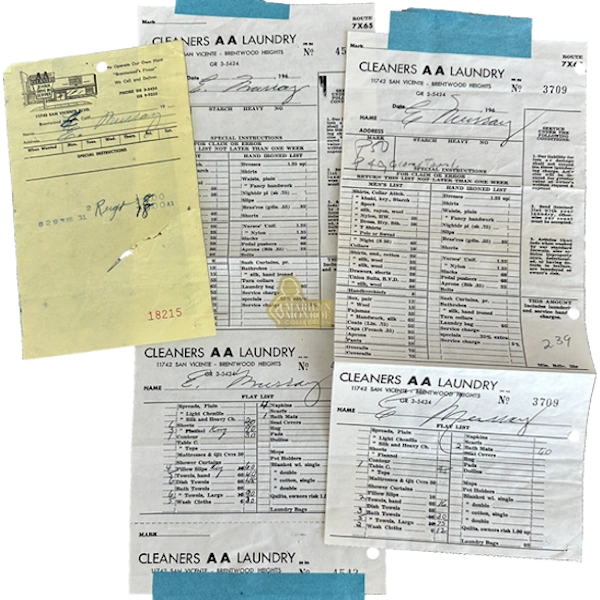
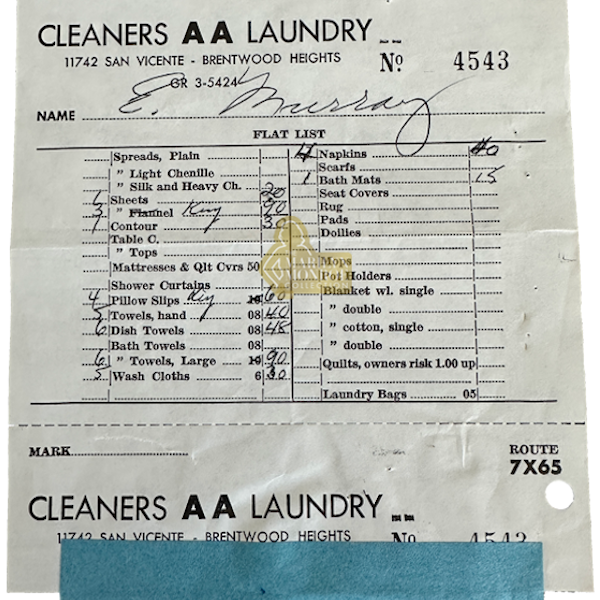
Marilyn used CLEANERS A A LAUNDRY service, as the above receipts clearly indicate. Please note that the customer’s name inscribed on the receipts was E. Murray: Eunice. Most certainly, like most if not all women, Marilyn hand washed some of her delicate under garments; but she did not need an automatic washing machine for that task. Receipts published here with the gracious permission of Scott Fortner, The Marilyn Monroe Collection.
The LAPD snapped the now famous photograph, pictured below, on the morning of August the 5th. Clearly, Marilyn’s small bedside table and all the objects that rested thereon were not perfectly arranged. not even neatly arranged; and just as clearly, a drinking glass rested on the floor between the trash can and bed. The Mexican jorum rested on the floor near the wall and to the left of the table. Upturned and placed over the neck of the jorum is a drinking vessel. I have seen a color photograph of that jorum: it is colorfully decorated with shades of red and brown.
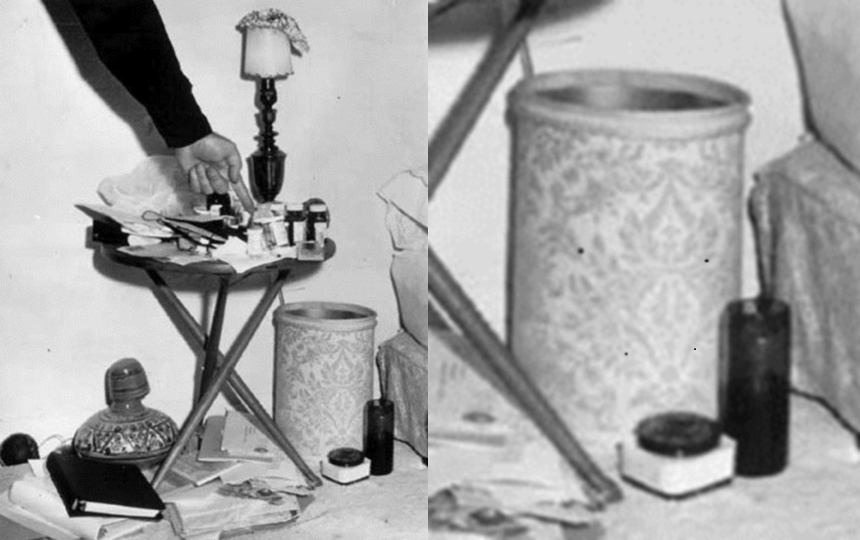
I must denote at this point, Fifth Helena Drive did not have a service porch off the kitchen as asserted by Sgt Clemmons according to Donald Wolfe. Drawings that Marilyn commissioned for her kitchen remodeling did not indicate a service porch and the listing of new appliances that the actress planned to purchase, for her remodeling, did not include a washer or a dryer. Additionally, when the hacienda was sold to the Nunez family after Marilyn’s death, the written declaration of appliances included in the sale did not include a washer or a dryer.
One final comment regarding the washing machine construct. Later in her text, Miryam wrote: […] if Marilyn committed suicide, why […] didn’t she vomit […]? (Moya 36). Miryam’s argument appeared to be thus: Marilyn’s death was not a suicide: Marilyn’s death was a homicide, so all the machinations enacted by Eunice Murray, Dr. Ralph Greenson and Dr. Hy Engelberg that morning were designed to suggest and support death by suicide. Sgt Clemmons even alleged, several years later, that the drinking glass in the police photograph was surreptitiously placed there by the three conspirators after he left the scene; or as the zealot Frank Capell would allege in 1964, Marilyn’s death was a murder dressed up to look like an accident or suicide, dressed up by Communist Agents dispatched by the dangerous Commie Robert Kennedy (Capell 68). So, if vomit or gastric foam or stomach reflux would have clearly pointed to the mode of death the conspirators needed or desired to confirm, why would they wash Marilyn’s sheets, and in so doing, remove that confirming evidence? That tactic seems to be patently illogical.
Be that as it may but most certainly, Mrs. Murray was not doing Marilyn’s laundry on the morning of August the 5th in 1962. Sgt Jack Clemmons fabricated the entire scenario. Sgt Clemmons will reappear herein later.