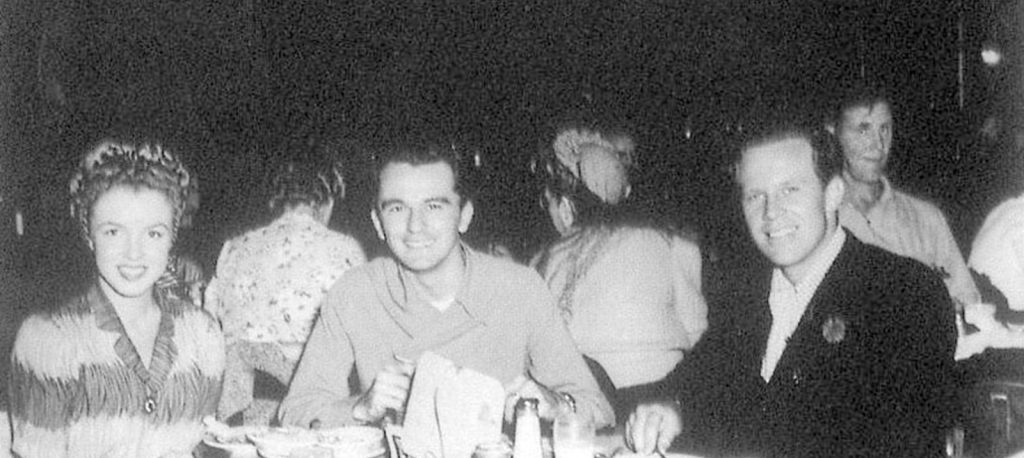
Eunice Murray, Robert Slatzer, Inez Melson and The Strip of Light
Ohio born newspaper reporter, writer and small time movie dilettante Robert Franklin Slatzer, appeared in the Realm of Marilyn in 1952 while she was filming Niagara. Using his press credentials, he finagled passes that allowed him to access a few filming locations, which he used to an odd and perverse advantage. After coercing Marilyn to pose with him for a few photographs, making a slight nuisance of himself,1Slatzer also asserted that he was friends with the mysterious Frank Neill, an employee of 20th Century-Fox, who helped him obtain his press passes. Despite my diligent efforts, I have not been able to learn anything at all about Frank Neill; I have not even been able to locate an obituary. He appeared in various Marilyn pathographies as a witness to Robert Kennedy’s alleged helicopter arrival and landing at a Fox lot on August the 4th in 1962.Robert F virtually disappeared until 1973 when publicity in the form of magazine and newspaper articles along with a synopsis of a soon to be controversial book, The Life and Curious Death of Marilyn Monroe, its authorship credited to Slatzer, began to appear here and there across the nation. Twelve years after Marilyn’s death, in 1974, Slatzer’s book appeared on the shelves of brick and mortar book shops in America. In 1975, Slatzer released another edition of the same book but under a different title, The Curious Death of Marilyn Monroe, a title that evoked the title of another book that had been published in 1964, written by Frank Capell, The Strange Death of Marilyn Monroe. Eventually the lives of Slatzer and Capell became entwined and both men will forever be connected to the death of the famous movie star; and their connection will forever be one of adulteration because each man added the pollutant of untruth. Remember, Slatzer claimed that he was married to Marilyn for three days in 1952. The possibility that Marilyn Monroe would have married Robert Slatzer, even for just a few days, during the time of her intimate relationship with Mr. Baseball, Joe DiMaggio, was and is patently absurd. More about that absurdity will appear later.
Miryam evoked the name of Robert Slatzer early in her narratively reconstructed account of Marilyn’s death. The expert crime scene reconstructionist mentioned the light under the door conundrum, the hotly debated narrow strip of light visible beneath Marilyn’s bedroom door. Originally, Mrs. Murray testified that this visible strip of light triggered her moderate alarm, which occurred at approximately 12:30 AM on August the 5th; but, as was often the case with Eunice Murray, she altered her story many years after the fact: she changed the trigger of her moderate alarm from the visible strip of light to a visible telephone cord passing under the bedroom door. The story of the light under the door collapses, Miryam asserted,
when you examine the layout of the house and the thickness of the carpeting. Robert Slatzer, a friend of Marilyn’s and one of the men who later returned to the residence to review details of the scene, observed this days later alongside Inez Melson, administrator of Marilyn’s estate and a key figure in the management of her immediate affairs. The newly installed carpet made it so difficult for the door to close properly that it would have been virtually impossible to see light beneath it (Moya 21: emphasis mine).
The first mistake Miryam made was declaring that Robert Slatzer was a friend of Marilyn’s. Marilyn and Slatzer were not friends. In fact, Marilyn and Slatzer were not even what might be termed distant acquaintances, as I will clarify as we proceed. Now, I do not want to quibble over the choice of words in the preceding quotation because I often break Mark Twain’s Golden Rule of Writing: I often employ the second cousin of the correct word. Still, according to Merriam-Webster’s on-line dictionary, virtually means practically, as in almost; very close to but not completely. Was a visible passage of light beneath the bedroom door possible or not?
Occasionally, during my tenure as a practicing architect, I found myself involved in projects that required dark rooms or other special function rooms from which the infiltration of light had to be completely occluded. Preventing the passage of light is difficult and requires the use of precise, specially designed and installed seals. A deep pile, wool carpet, which the new carpet in Marilyn’s bedroom was, and a thirty-three-year-old wooden door with a snug fit against the carpeting would not have sufficed. Besides, as the photograph below clearly demonstrates, a strip of light was visible beneath Marilyn’s bedroom door.
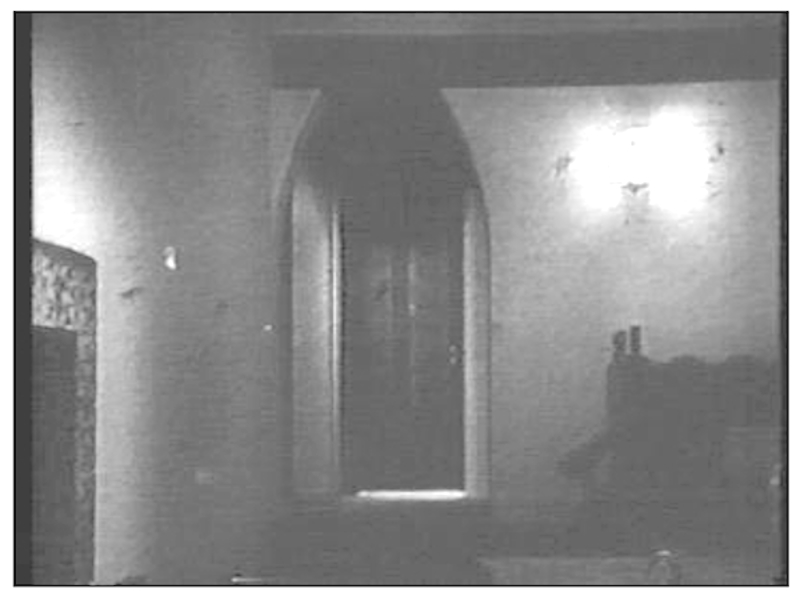
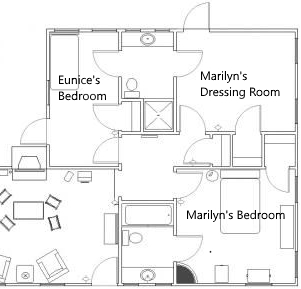
Taken in the 1960s, the above photograph clearly revealed that light could be seen beneath Marilyn’s bedroom door. Miryam implied that the configuration of Marilyn’s hacienda would have precluded Mrs. Murray from seeing Marilyn’s bedroom door unless she left her bedroom. The plan of the bedroom wing of Marilyn’s hacienda clearly disproves that implication. Photograph used with the gracious permission of Gary Vitacco-Robles, who published the photograph in ICON: What Killed Marilyn Monroe, Volume One.
Please note: Although I labeled the room occupied by Eunice on August the 4th as her bedroom, Marilyn actually used that space as a Guest Room, and it contained a cot. It is the room in which Pat Newcomb had slept the night before. Marilyn had plans to convert the detached space between the house and the garage into an actual Guest Area. She planned to have it ready when her friend, the poet Carl Sandburg, arrived for an extended visit.
Considering that the preceding photograph irrefutably answers the question about a visible strip of light beneath Marilyn’s bedroom door, there is no need to linger over the light strip, no light strip debate. To me, the important consideration is why Mrs. Murray changed her story. Also, when did she and where was she when she changed it? I could present a mountain of details, falsities and contradictions as a means of getting to the navel of those issues; but there is little need to linger over all that as well, since all the details, falsities and contradictions are available on this website. If you have not already done so, please visit Murder Orthodoxies, Section 4, An Alleged Second Husband for a mountain of additional information about the fantasist, Robert Slatzer.
Robert Slatzer has been credited with writing two books starring Marilyn Monroe, his 1974 publication about Marilyn’s curious life and death, and The Marilyn Files, published eighteen years later in 1992. Within the text of his 1974 literary effort, he referenced an interview with Mrs. Murray that had occurred in August of 1973, when he was purportedly writing his first book; he did not identify the actual date or day of the week on which the interview transpired (Slatzer 30). Later in that literary effort, Slatzer asserted: I recently had the opportunity to speak with Mrs. Eunice Murray, and she reconstructed from memory the events of that last Saturday (Slatzer 266: emphasis mine). Obviously Slatzer was referring to his purported 1973 interview with Mrs. Murray, an interview, he asserted, that he had tape recorded.
While Slatzer did not specify the actual calendar date of his purported taped interview with Mrs. Murray, the conspiracist author Donald Wolfe did; but Wolfe’s attributed date suffers from a serious chronological problem: Wolfe translated the date back in time eleven years to 1962 just one day after Marilyn’s funeral. After Marilyn Monroe’s friend Robert Slatzer learned of her death, Wolfe wrote,
he went to the Monroe residence with executrix, Inez Melson, on Thursday, August 9. Slatzer noted that the recently installed carpeting was so thick that it was difficult to close Marilyn’s bedroom door. The door scraped along the surface of the carpet, and it was impossible to see light beneath it. Murray, who was present during Slatzer’s discovery, admitted that he was correct and that she must have been mistaken (Wolfe 17).
In Robert Slatzer’s 1974 book, Inez Melson appeared only twice; and Slatzer did not mention that Inez was involved in his 1973 Eunice Murray interview. He certainly did not mention an interview with either woman that transpired on August the 9th in 1962. In fact, Donald Wolfe’s translation of the alleged Melson–Murray interview to the day following Marilyn’s funeral contains a chronological hiccup, to say the least. Here’s the hiccup.
On August the 11th, just three days after Marilyn’s funeral, the Columbus Star featured a gossip section article written by Paul Pry, Jr. The article indicated that Slatzer was in Ohio when Marilyn died: Bob Slatzer read in Monday’s paper, the article noted, that Marilyn Monroe’s body lay unclaimed in a Los Angeles morgue.2William Randolph Fowler Collection, Folder 24, File 5, pages 84 and 85.Obviously, Monday’s paper referred to August the 6th’s edition of the Columbus Star. Over the years following Marilyn’s death, Slatzer asserted several times that he attempted to claim Marilyn’s body and arrange for her burial, which appears to be disproven by the Columbus Star article: Bob Slatzer was in Columbus, Ohio, on August the 6th in 1962.
Other contradictory and dubious declarations about his geographic location at the time of Marilyn’s death and her funeral, along with other reliable sources who described Marilyn’s funeral, appear to prove conclusively that Robert Slatzer was nowhere near the Westwood Village Memorial Park in 1962 on August the 8th; but the habitual fantasist apparently could not resist the following fantasy: Slatzer declared in the introduction to his 1992 publication: At Marilyn’s house with Inez Melson before the burial services, I again saw the places she loved so much and realized that now all those high hopes had died, too. Thirty years after the Columbus Star article placed him in Ohio, Slatzer remarkably recalled that he attended Marilyn’s funeral with Inez Melson; and yet, the memoir written by Marilyn’s sister, Berniece Miracle, recalled Marilyn’s funeral in precise detail along with some intimate but disconsolate interactions with Inez Melson. Berniece did not mention the presence of Robert Slatzer; and not one of the many photographs snapped on August the 8th in 1962 and not one of the many newsreels or home movies that captured Marilyn’s interment revealed the presence of Robert Slatzer, who, in his 1974 publication declared the following: I was at my home in Columbus, Ohio. It was early Sunday morning, August 5, 1962, when the persistent ringing of the phone roused me from an exhausted short-lived sleep. Slatzer’s close friend and neighbor unceremoniously, succinctly relayed the bad news: Marilyn’s dead (Slatzer 49). But wait! There’s more! Later in the same publication, Slatzer remarkably declared the following:
On the afternoon on the funeral I was at home in Columbus with four close friends […]. Late Wednesday afternoon, after the others had gone, Emerson Burkhart and I were left alone to empty the last bottle of brandy. The only one of the group who had ever met Marilyn, Burkhart was deeply moved by her death. […] After Emerson left, I felt lost. I didn’t feel much like staying at home alone, so I slipped into some old clothes, grabbed my hip boots, pulled out my favorite St. Croix fly rod, and drove into the autumn countryside. In the fading afternoon, which Marilyn had loved so much, I fished for bass in a secluded spot at Greenwood Lake, in Delaware County, Ohio (Slatzer 299: emphasis mine).
I, for one, must express a considerable amount of dazed confusion and incredulity, the shameless dishonestly of Robert Slatzer notwithstanding. Was he in Los Angeles with Inez Melson on August the 8th in 1962? Or was he with friends that afternoon and then later that day, alone with his memories and morose thoughts as he fished for bass in a secluded spot at Greenwood Lake, in Delaware County, Ohio? Now, I suppose, in 1962, Slatzer could have boarded a red-eye flight in Columbus late on that Wednesday, the 8th, and arrived in Los Angeles in time for an interview with Inez Melson and Eunice Murray sometime on the afternoon of the 9th; but that evidently did not occur, as the following clearly proves.
On the day following Marilyn’s funeral, the 9th of August in 1962, the day Donald Wolfe asserted that Slatzer actually interviewed Inez Melson and Eunice Murray together, the memoir written by Marilyn’s sister,3Marilyn’s half-sister, Berniece and her daughter, Mona Rae, Marilyn’s half-niece, co-wrote the memoir, My Sister Marilyn: A Memoir of Marilyn Monroe, published in 1994, eBook in 2013.which included her recitation of that day’s events, reported that August the 9th began in Milton Rudin’s office, an early morning meeting with Aaron Frosch to discuss Marilyn’s “Last Will and Testament.” After that meeting, Marilyn’s sister, Berniece. and Marilyn’s niece, Mona Rae, returned to 12305 Fifth Helena, along with Inez Melson, where they searched through Marilyn’s belongings and documents. According to Mona Rae, on August the 8th, when Slatzer, remember, was in Ohio drinking brandy and fishing:
After the funeral, Inez, who was appointed by Frosch and the court to act as administrator, and I, and Cherie [Redmond], a secretary who had done some work for Marilyn, spent three days—meaning August the 8th, 9th and 10th—at Marilyn’s home checking through all her belongings. I was there just to help in an unofficial capacity (Miracle 224-225).
Mona Rae recalled that her mother, Marilyn’s sister, sat tearfully at her task, hour after hour, as the three women [picked] through stacks of paper like amateur archaeologists (Miracle 225). Within the pages of Berniece’s memoir, Robert Slatzer is completely absent; he is nowhere to be found. In addition to Slatzer’s absence from Berniece’s memoir and her chronicle of those August the 9th events, Berniece, along with Cherie Redmond, are also absent from the events of August the 9th and the Melson–Murray interview as reported by the conspiracist Donald Wolfe; but then Wolfe, like many others, blindly believed Robert Slatzer. Evidently, Wolfe and author Anthony Summers, if they actually read Robert Slatzer’s fraudulent publications, they did not peruse those texts. Did Miryam Moya peruse Slatzer’s writings? I must express doubt that she did. We are left to wonder why?
If we accept Robert Slatzer’s anecdote—always a dangerous position to assume with Robert Slatzer—unquestionably, Eunice Murray altered her story regarding the visible strip of light and telephone cord running beneath Marilyn’s bedroom door; but unquestionably, also, she did not alter her story in 1962. Eunice must have altered her story in 1973 due to the coercive and manipulative Robert Slatzer; and she was not standing within the walls of 12305 Fifth Helena either. The only explanation I can offer regarding why Donald Wolfe time warped and shifted Slatzer’s alleged interview with Mrs. Murray, making it contemporaneous to Marilyn’s death, is this: to give Sgt Jack Clemmons’ allegation that the housekeeper altered her testimony for nefarious and sinister reasons, to give that specific allegation some validity. I must denote here: Donald Wolfe and Sgt Jack Clemmons became very good friends while Wolfe wrote his ridiculous and goofy book.
But, Eunice’s testimonial alteration, a contradiction of sorts, still remains to be explained.
If I learned anything at all about Eunice Murray as I researched her life, I learned that she was a meek, soft spoken and mild mannered woman. Mrs. Murray was the type of person who said what she believed the other persons in her company at any particular moment wanted to hear; and some Marilyn experts have noted that Eunice generally supported the murder orthodoxy that happened to be the most popular at the time of her interviews; or she supported the murder orthodoxy also supported by the conspiracist performing her interview at that moment. Additionally, she once admitted that she merely said what she thought sounded the best at the time: she frequently contradicted herself, particularly when talking about Marilyn’s relationship with Robert Kennedy. Furthermore, as evidenced by her relationship with Dr. Greenson, Eunice was easily manipulated. She was undoubtedly motivated by an ingrained compulsion to please men through a religiously implanted acquiescent complaisance, no doubt implanted during her childhood and by her Swedenborgian religion. How can anything Eunice Murray ever said be considered reliable? The only honest and prudent answer to that question is this: nothing she ever said can or should be accepted at face value simply because Eunice Murray was an unreliable witness.
Still, all the yarns and stories that precede lead to the following facetious assertion: Slatzer, who was also an unreliable witness, must have been cloned, so there must have been multiple identical Slatzers; that must have been the case, which bestowed upon him, tantamount to getting a gift from God, the amazing ability to be in two places at once and in different decades; but not one of those multiple, time traveling Slatzers had the ability to tell the truth. The truth is: light was visible beneath Marilyn’s bedroom door, a proven fact, proven by a sixty-year-old photograph.
Marilyn owned two vertical filing cabinets, one she kept in her dressing room at 20th-Century Fox and the other in her detached guest cottage at Fifth Helena.4Anthony Summers asserted, based on testimony from an unidentified policeman, that One of Marilyn’s vertical cabinets resided in her Sunroom. It has been frequently reported by sundry authors that, on the night of her death, various individuals broke into the filing cabinets and removed pile after pile of documents, removed evidence of Marilyn’s affairs with the middle Kennedy brothers. One author even reported that the ransackers burned many of those purloined documents in Marilyn’s large fire place. Odd, though, not one photographer snapped a photograph of those wrecked filing cabinets. It is worth noting here, that in 1964, Frank Capell did not reference any plundered filing cabinets. In 1963, Edwin Hoyt did not reference any plundered filing cabinets in his Marilyn biography, the one Mark Shaw praised for its accuracy. Ten years later, Norman Mailer did not mention Marilyn’s ransacked and burned documents, either. In fact, the mythology of the plundered filing cabinets began with Robert Slatzer in 1974. He asserted that Marilyn told him that important documents had started to disappear from her filing cabinet. Which one specifically, Slatzer never identified. Still, the filing cabinets, pictured below, display no evidence of damage. Of course, the cabinets could have been repaired; but there exists no evidence that they were ever broken into, damaged, contents rifled and emptied.

The author Donald Wolfe was the most effusive about Marilyn’s filing cabinets; but Wolfe received his information from Robert Slatzer. Wolfe wrote:
“Inez was going through what remained of Marilyn’s papers in the file cabinet kept in the guest cottage,” Slatzer recalled, “She told me that when she arrived at the house early Sunday morning she discovered the cabinet had been broken into and many of Marilyn’s things were missing. It was obvious that the lock had been forcibly broken” (Wolfe 79).
It is more than clear, based on Slatzer’s written declarations, that he was not in Brentwood the day Marilyn was entombed; and Berniece and Mona Miracle’s memoir did not include Robert Slatzer in the activities of August the 9th, despite what Donald Wolfe alleged. If the women mentioned by Berniece and Mona Rae spent three days sorting Marilyn’s documents, then there must have been plenty of them to sort. Also, the Miracle’s recollections of that day did not feature any damaged filing cabinets.
Donald Spoto offered this:
Back at Fifth Helena, the police remained in charge. Later, there were ridiculous reports that Fox executives had ordered the “burning [of] a pile of documents in the huge Mexican fireplace.” There were also rumors that “the locks on Monroe’s metal filing cabinet had been smashed with a crowbar and the drawers rifled” in order to remove documents compromising the security of the United States government. This is all utter nonsense, according to Officer Don Marshall, who was present all day: “Nobody was destroying anything” (Spoto 580).
Finally, from a Spoto footnote: As for a small cache of Marilyn’s personal letters and papers, they were duly removed next day by Inez Melson, after whose death in 1986 they passed first to a collector, thence to D[onald] S[poto] (683).